Black-naped Oriole, Chengching Lake, May 15th

A pair of Black-naped Orioles is currently easily viewable feeding young at Chengching Lake in central Kaohsiung.

To see the birds, enter the lake area through the main gate at the southern end. Entry is free for Kaohsiung residents with supporting ID, otherwise a small fee is payable. Once inside, follow the road to the left. After 1.3km, the road turns sharply to the right, and two pagodas with red pillars and grey-green roofs can be seen to the right, at the edge of the lake. Park and walk to the pagodas. The nest is in trees next to the pagodas, directly above the trail, and the birds can be easily seen coming and going. They’re popular with photographers, so you probably won’t have the place to yourself!

Also seen during my visit this morning were several Asian Glossy Starlings, and good views of Taiwan Barbet and Grey-capped Pygmy Woodpecker, both of which are numerous and easily seen at this site.

Taiwan tick: Black-naped Oriole.

Azure-winged Magpie, Tainan, May 13th

A hot and humid day, with heavy showers already bubbling up by noon. I followed last Saturday’s birding route, starting in the coastal pines at Qigu, working my way south then east around the levee, then checking out the trees and marshes on the southern side of the Tsengwen river.

There was no sign of any of Saturday’s interesting birds, and migrants were far fewer in number today. It’s starting to feel like summer here.

At Qigu, a smart Long-toed Stint was probably the highlight. Numbers of the common passage waders were in the low single digits only, but 25 Avocets were still hanging around one of the pools along the levee. Nothing of note in the coastal forest apart from 2 Arctic Warblers still. A lone Caspian Tern was back at the marshes, several Little Terns were around, and about 8 Greater Crested Terns fished offshore.

On the south side of the estuary, there was no sign of Saturday’s Asian Dowitcher. Just as the rains arrived, I finally rescued a tick for the day, with two Azure-winged Magpies in the grounds of Sihcao Artillery Fort. This is an introduced species in Taiwan, and despite being somewhat “plastic” is still a nice bird to see.

Taiwan tick: Azure-winged Magpie.

Asian Dowitcher and terns, Tainan area, May 10th

Highlights:

  • Asian Dowitcher 1
  • Gull-billed Tern 1
  • White-winged Tern 4
  • Greater Crested Tern 5
  • Ruddy-breasted Crake 1
  • Little Bunting 1
  • Chinese Sparrowhawk 1
  • Black-shouldered Kite 2
  • Arctic Warbler 2
  • Brown-headed Thrush 1

Other waders seen: Broad-billed Sandpiper, Curlew Sandpiper, Marsh Sandpiper, Sharp-tailed Sandpiper, Red-necked Stint, Avocet, Whimbrel, Grey-tailed Tattler, Grey Plover, Pacific Golden Plover, Greater Sandplover, Mongolian Plover, Kentish Plover, Common Greenshank, Common Redshank, Common Sandpiper.

Migrants continue to trickle northwards along the Taiwan coast, and some interesting oddities were seen during a four hour visit to the Qigu and Tainan marshes this morning. The showery weather of the last few days has probably helped to ground a few migrants; for example it was notable that Brown Shrikes were very numerous today.

In terms of rarity, the outstanding highlight was an Asian Dowitcher on a pool just inland of the coastal belt of woodland, on the southern (Tainan) side of the Tsengwen estuary. At first, all too briefly, it was close to the road associating with three Avocets and a couple of Marsh Sandpipers. However, a passing scooter soon flushed it to the far side of the pool, where it showed well but rather distantly. Unlike the full breeding-plumaged individual I found at Aogu last weekend, this bird was only just starting to moult into summer plumage, and had a rather strong head pattern with a distinct supercilium; it was also up to its belly in water and for a brief moment I wondered if it could be a Long-billed Dowitcher, but it soon wandered into shallower water where its black legs could be seen. The thick, all-black and “drop-tipped” bill is also a giveaway even at long range.

Two self-found Asian Dowitchers in just seven days is lucky indeed, but I couldn’t help wanting to trade at least one of them for a Nordmann’s Greenshank, the only East Asian shorebird I still haven’t seen. Such is birding!

Elsewhere, the coastal pine forest at Qigu produced two Arctic Warblers and a Brown-headed Thrush, in other words similar birds to last week but minus the rarities. A migrant Chinese Sparrowhawk flew north along the coast, a year tick for me, while two Black-shouldered Kites were in the area. Today, I drove the full length of the levee road around the Qigu marshes, where the best bird was a superb Little Bunting beside the road, my second rare migrant bunting species this week after Tuesday’s Tristram’s Bunting at Donggang.

There weren’t many waders on Qigu marshes today; the water level was high, limiting the amount of exposed mud. However, a Gull-billed Tern here was a Taiwan tick for me. Offshore, Greater Crested Terns fished in the mouth of the Tsengwen Estuary, while further around the levee on a reedy pool, I disturbed a Ruddy-breasted Crake which gave me a five-second view before it disappeared into cover. A flooded rice paddy held a big mixed flock of breeding-plumaged Broad-billed, Curlew and Sharp-tailed Sandpipers and Red-necked Stints.

The bird I enjoyed the most today is a fairly common passage migrant in Taiwan: White-winged Tern. There were three of them with Whiskered Terns at fishponds next to Highway 17 near Cheting, and another overflew the Tainan marshes. It’s a dazzling bird in its spring plumage, and one I cannot imagine ever getting tired of seeing.

Taiwan ticks: Gull-billed Tern, Little Bunting. Year ticks: Chinese Sparrowhawk, White-winged Tern.

Tristram’s Bunting, Donggang, May 6th

Today dawned cool, drizzly and misty – ideal conditions for seeing migrant birds on the coast – so off I went to try and find a suitable location for grounded migrants at Donggang.

The place I particularly had in mind was a mile-long stretch of the seawall, just south of Donggang town and west of the big Dapeng Bay bridge. An extensive overgrown cemetery, patches of trees and a scattering of ponds here offer plenty of cover for tired birds.

It turned out to be a morning of quality over quantity. I hit the jackpot with a splendid male Tristram’s Bunting, which showed very well along the roadside and among the overgrown gravestones of the cemetery. Tristram’s Bunting is a perfect “birder’s bird” – an enigmatic, unobtrusive East Asian speciality, but easy to identify, and stunning-looking with its richly toned colors and black-and-white striped head. I’ve seen them on a number of occasions in Korea, but it’s not a bird I had given any thought to seeing in Taiwan as they are such rare visitors here.

An hour later, and half a mile further east, I had another sighting of a male Tristram’s Bunting along the roadside. Given its rarity, I can only assume that it was the same bird that had moved along the coast.

Not a lot else in this area except for unusually good views of a migrant Oriental Reed Warbler, and a scattering of Brown Shrikes.

Nearby, in Dapeng Bay, still one Chinese Egret on the mudflats. Also here, an Oriental Pratincole (my first record for this site), a much-reduced scattering of passage waders (“only” 13 wader species today), and 68 Greater Crested Terns counted on and around the fishing platform in the bay.

Tristram’s Bunting is my 222nd Taiwanese bird species, and my 187th for this year.

Fairy Pitta, Huben area, May 4th

Fairy Pitta, Linnei Park, May 4th.

Fairy Pitta, Linnei Park, May 4th.

This was a trip I’d been anticipating for a long time: an early May visit to Huben in central Taiwan, which is famous for being a reliable breeding area for the globally endangered and declining Fairy Pitta.

The birds return from their wintering grounds in Borneo in late April. They are vocal and conspicuous on their breeding territories until mid-late May, but become quiet and very elusive as the summer progresses. I reckoned I had picked just about the peak weekend for my best chance to see this stunning bird.

I arrived late on Saturday afternoon after an excellent day birding the West Coast wetlands. My first port of call was the Pitta Cafe.

The excellent Pitta Cafe in Huben Village, a good place to go for the latest information on Fairy Pittas in the area.

The excellent Pitta Cafe in Huben Village, a good place to go for the latest information on Fairy Pittas in the area.

The Pitta Cafe offers accommodation as well as food and drinks; rooms are basic, clean and comfortable and cost just 500NT including breakfast. The owners speak a little English and are well used to birders and their early morning starts – they were willing to make breakfast for me at any time from 4am onwards!

I went to sleep to the sound of a Mountain Scops Owl calling nearby.

Note on my door at the Pitta Cafe .... now that is excellent service.

Note on my door at the Pitta Cafe …. now that is excellent service.

The morning dawned grey and drizzly, but a calling Taiwan Hill Partridge in the distance felt like a good omen for the day! I elected to join the promised 6.00am Fairy Pitta-finding activity and it turned out to be an excellent decision. This involved driving with the Pitta Cafe owner for about 10 minutes to Linnei Park, on the outskirts of Linnei township. This is an area of dense, damp lowland forest, prime breeding habitat for Fairy Pittas.

On arrival, at around 6.15am, we were met by some 30 birders, photographers and schoolchildren, all keen for a glimpse of the pitta. This large group walked into the forest, talking loudly all the while, and I was beginning to regret my decision to join the tour. I needn’t have worried – just 5 minutes walk into the forest, everyone suddenly stopped when one of the group leaders disturbed a Fairy Pitta from right next to the path. It flew up into some bamboo and showed fairly well before flying deeper into the forest.

Fairy Pitta dates of first arrival and total numbers in the Huben area since 2006. There has been an overall steep decline in recent years, but thankfully numbers rebounded a little last year.

Fairy Pitta dates of first arrival and total numbers in the Huben area since 2006. There has been an overall steep decline in recent years, but thankfully numbers rebounded a little last year.

A little further on, a clearing in the forest was being staked out by at least 40 photographers. I waited for about 10 minutes, then suddenly a Fairy Pitta came down to the clearing. It showed extremely well, not bothered at all by the long lenses just 15 feet away from where it hopped around on the ground. It felt like a most unlikely way to see a pitta, which are notorious for being very shy and elusive. Here, they must be well-used to their legions of admirers!

Fairy Pitta, Linnei Park, May 4th.

Fairy Pitta, Linnei Park, May 4th.

The pitta even indulged in some singing, which was loud enough to not be drowned out by the incessant clicking of the cameras. Well satisfied with this sighting, I returned to the trail, where another Fairy Pitta was calling from a thicket, and at least two further males were heard singing in the general area. It was remarkable how many photographers were in the general area (more than 100!) and how little it seemed to disturb the Fairy Pittas.

The only other bird of note was a Bronzed Drongo, which showed well beside the path:

Bronzed Drongo, Linnei Park, May 4th.

Bronzed Drongo, Linnei Park, May 4th.

Fairy Pitta takes my life list to 1,773 species. The pitta plus Asian Dowitcher, Red Knot, Ruddy Kingfisher, Asian Paradise-Flycatcher and Barred Buttonquail, all seen this weekend on the west coast, bring my Taiwan life list to 221 and my 2014 year list to 186 species.

Asian Dowitcher and Taiwan rarities, West Coast wetlands, May 3rd and 4th

Coastal pine forest on the north side of the Tsengwen Estuary at Qigu: a hotspot for rare migrants.

Coastal pine forest on the north side of the Tsengwen Estuary at Qigu: a hotspot for rare migrants.

Highlights:

Waders: 28 wader species were seen. Counts are extremely approximate (100s = “hundreds”!). I stopped in for mainly brief visits to Cheting, Qigu, and Budai, but I spent much longer at Aogu.

  • Asian Dowitcher 1
  • Great Knot 1
  • Red Knot 10
  • Curlew Sandpiper 1000+
  • Broad-billed Sandpiper 100s
  • Sharp-tailed Sandpiper 100s
  • Marsh Sandpiper 80
  • Terek Sandpiper 25
  • Grey-tailed Tattler 3
  • Wood Sandpiper 2
  • Common Sandpiper 2
  • Long-toed Stint 2
  • Red-necked Stint 100s
  • Dunlin 6
  • Whimbrel 5
  • Eastern Black-tailed Godwit 40
  • Avocet 50
  • Spotted Redshank 9
  • Common Greenshank
  • Common Redshank
  • Grey Plover 1
  • Pacific Golden Plover
  • Greater Sandplover
  • Mongolian Plover
  • Kentish Plover
  • Ruddy Turnstone 4
  • Snipe sp. 1
  • Black-winged Stilt

Other birds:

  • Ruddy Kingfisher 2
  • Asian Paradise-Flycatcher 1
  • Arctic Warbler 1
  • Brown-headed Thrush 2
  • Oriental Cuckoo 1
  • Barred Buttonquail 1
  • Savanna Nightjar 1
  • Richard’s Pipit 1
  • Black-faced Bunting 2
  • Long-tailed Shrike 2
  • Black-shouldered Kite 2
  • Chinese Egret 1
  • Cinnamon Bittern 1
  • Black-faced Spoonbill 40
  • Caspian Tern 30
  • Whiskered Tern
  • Little Tern
  • Black-headed Gull 1

The above highlights list says it all; this was a superb weekend with quite staggering numbers of some wader species, plus an excellent sprinkling of non-wader scarcities and just generally some damn good birding. If only it could be early May all year round.

To make things even better, the above birds were merely the bread in a Fairy Pitta sandwich, the main reason I headed to central Taiwan this weekend. But more on that later.

I headed north from Kaohsiung early on Saturday morning, and a 10-minute stop at Cheting provided a gentle warm-up. On the main lagoon, there were a couple of Greater Sandplovers, some Red-necked Stints and Sharp-tailed Sandpipers, and a lone Curlew Sandpiper. The latter bird was a precursor to at least a thousand more seen during the course of the weekend; its description as an uncommon migrant in Brazil’s book Birds of East Asia seems to be very inaccurate, at least as far as the west coast of Taiwan in early May is concerned.

Next, onwards to Qigu; a breeding-plumaged Chinese Egret strutting around in front of the Black-faced Spoonbill center was an excellent find, my tenth individual Chinese Egret of the spring. There were also around 25 Terek Sandpipers here, a bird I didn’t see at all at the other wetland sites this weekend. Further north again, and a couple of stops in the Budai area produced 9 late Spotted Redshanks, a couple of Eastern Black-tailed Godwits, and two Ruddy Turnstones. Nothing to get the pulse racing just yet, but very enjoyable birding and plenty of lovely breeding-plumaged waders to look at.

I was excited for my first visit to Aogu wetlands, an oblong of land that juts out into the sea in Chiayi County. It’s a big area and unfortunately, not knowing any better, I wasted a fair amount of time in the interior, which is covered mainly with eucalyptus and other trees interspersed with occasional marshes. There were a lot of common birds in there, but the only species of note was a Barred Buttonquail (year tick) beside one of the dirt roads.

Finally, I found my way into the sea wall, which skirts the entire perimeter of the area and has a convenient road running along its entire length (and even some birding hides). This was nice easy birding, just cruising along on the scooter and stopping to scan with the pools through my scope whenever wader flocks were seen. The marshes and pools here are quite extensive, and birds were truly abundant; probably the total number of Curlew Sandpipers I saw here today outnumbered all my previous sightings of this species put together.

I didn’t see any real rarities the first day, but several Red Knots were around (Taiwan tick) and a single Great Knot. It felt a little odd searching for the very scarce Dunlins among the Curlew Sandpipers; growing up in England, the opposite scenario was always the case.
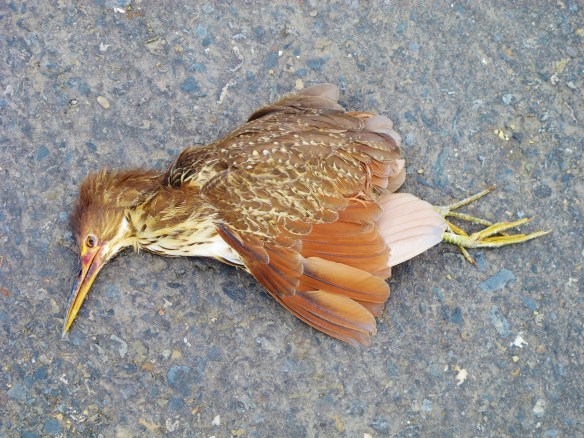
Female Cinnamon Bittern, sadly found recently dead on the road near Budai.

Female Cinnamon Bittern, sadly found recently dead on the road near Budai.

On the second morning, I finally found the rarity I was looking for: a superb breeding plumaged Asian Dowitcher, showing at quite close range. After enjoying this bird for a while, I proceeded along the embankment and just 200 yards later encountered a tour group of British birders. I showed them the dowitcher, which was a lifer for one of the group; there’s nothing better than finding a rare bird and being able to share it with others for once. This is a very unusual scenario in Taiwan, where I virtually never run into other English-speaking birders.

Finally in Aogu, along the north side of the embankment, an area of scrub, murky ponds, and dried-out reedbeds produced a few oddities; a twice-flushed Savanna Nightjar, an Oriental Cuckoo, a Black-faced Bunting, and two flyover Black-shouldered Kites.

Photographers watching one of the two Ruddy Kingfishers present in coastal forest at Qigu, May 4th.

Photographers watching one of the two Ruddy Kingfishers present in coastal forest at Qigu, May 4th.

By now it was 1pm on Sunday, and it was time to leave and start making the long drive south towards Kaohsiung. As I passed near Qigu, on a whim I decided to make the 20-minute roundtrip detour from Highway 17 and call in there again. The tour group of British birders was just leaving the Black-faced Spoonbill hide as I arrived. They hadn’t seen much from the hide, but were headed to an area of coastal forest nearby that sometimes produced rare migrants: a narrow belt of pine trees and driftwood, literally on the white sand beach at the northern mouth of the Tsengwen River. We weren’t alone in this Robinson Crusoe-like setting today; the presence of about 50 excited bird photographers, and easy banter with the British birders, reminded me strongly of birding the north Norfolk coast. The photographers were there to see the two Ruddy Kingfishers that were present – this is not only a Taiwan rarity, but is also an extremely attractive bird, hence the large numbers of photographers. We also saw the long-staying Asian Paradise-Flycatcher here, a common SE Asian species that is a rare migrant in Taiwan. An Arctic Warbler and two Brown-headed Thrushes also showed themselves in the pines, plus a mystery bird that, on the very brief flight glimpses obtained, appeared to be an unusually chestnut-colored accipiter.

Taiwan ticks: Asian Dowitcher, Red Knot, Ruddy Kingfisher and Asian Paradise-Flycatcher. Year tick: Barred Buttonquail.
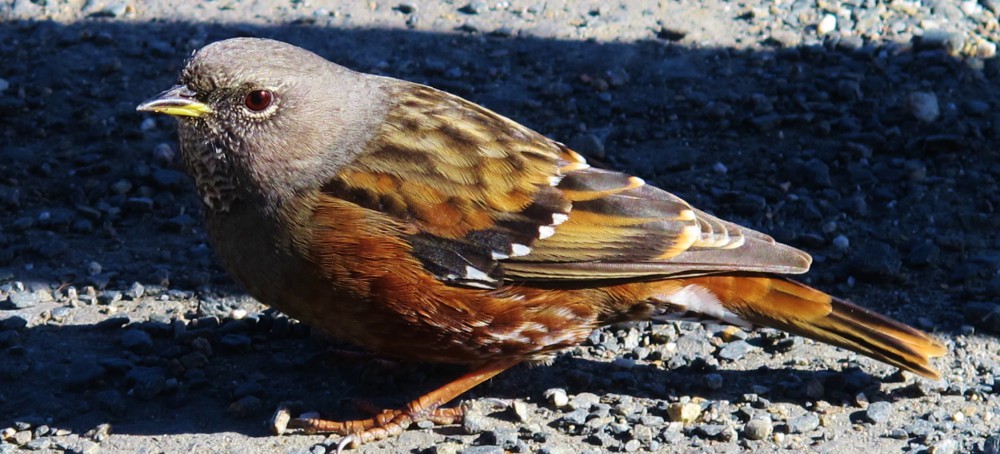
Chinese Egret, Dapeng Bay, May 1st

Chinese Egret and waders, Dapeng Bay, May 1st.

Chinese Egret and waders, Dapeng Bay, May 1st.

Highlights (wader counts are approximate):

  • Chinese Egret 5
  • Osprey 1
  • Broad-billed Sandpiper 120
  • Terek Sandpiper 10
  • Sharp-tailed Sandpiper 5
  • Curlew Sandpiper 30
  • Grey-tailed Tattler 40
  • Whimbrel 12
  • Long-toed Stint 1
  • Red-necked Stint 15
  • Greater Sandplover 5
  • Mongolian Plover 60
  • Grey Plover 1
  • Pacific Golden Plover 80
  • Kentish Plover 10
  • Common Greenshank 10
  • Common Redshank 15
  • Black-winged Stilt 50

A fairly short morning visit to the usual wader pools, in somewhat gloomy weather conditions with occasional outbreaks of light drizzle. A grand total of five Chinese Egrets stole the show today, several of them showing very well at close range. They are beautiful birds, and seemingly regular (even common!) at this site on migration.

An Osprey was also present which spent most of its time loafing on the mud, but occasionally attempted an (unsuccessful) fishing foray into the bay.

Wader-wise, it was another big day for variety, with seventeen species noted. Broad-billed Sandpiper was the most numerous wader today, with around 120 counted; this species is listed as “uncommon” in Brazil’s Birds of East Asia, but they seem easy to find, even numerous, in suitable habitat on the west coast of Taiwan in late April and early May.

An ID challenge was presented by an intriguing stint that was consorting with the main Broad-billed Sandpiper flock. Unlike all the Red-necked Stints seen today – and indeed, almost all the Red-necked Stints I’ve seen over the last few weeks – this one was still completely in its grey non-breeding plumage. It always stayed with the Broad-billed Sandpipers, never venturing to join the Red-necked Stint flock feeding nearby. To my eyes, it appeared a little shorter-bodied and less elongated than Red-necked Stint. I suspected it was a Little Stint, but as this bird was still in full winter plumage it was impossible to reliably distinguish it from Red-necked Stint. So it will have to stay off the list, unless of course it stays for a while and moults into breeding plumage, in which case ID will be rather more straightforward.

Great Knot and Savanna Nightjar, Dapeng Bay and Donggang area, April 27th

Highlights (with approximate counts for some species):

Dapeng Bay:

  • Great Knot 8
  • Broad-billed Sandpiper 30
  • Sharp-tailed Sandpiper 30
  • Terek Sandpiper 8
  • Grey-tailed Tattler 1
  • Long-toed Stint 2
  • Red-necked Stint
  • Wood Sandpiper 1
  • Common Sandpiper 1
  • Marsh Sandpiper
  • Common Greenshank
  • Common Redshank
  • Whimbrel 1
  • Dunlin 2
  • Black-winged Stilt
  • Ruddy Turnstone
  • Pacific Golden Plover
  • Grey Plover
  • Mongolian Plover
  • Kentish Plover
  • Little Ringed Plover
  • Greater Crested Tern 72
  • Whiskered Tern 1
  • Little Tern 5
  • Yellow Bittern 1
  • Eastern Yellow Wagtail 2

Donggang Bridge:

  • Savanna Nightjar 1
  • Grey-tailed Tattler 1
  • Little Ringed Plover 2

The mudflats and pools at the north-eastern corner of Dapeng Bay are currently a fantastic area to observe a wide range of wader species, with easy viewing from the cycle road, reasonable range, and excellent light in the morning. During a two-hour visit this morning, I observed no fewer than 18 wader species at this one spot, with three additional species elsewhere in the area.

Today’s highlight was a small party of 8 Great Knot, several of which were in full summer plumage. This is a distinctive, attractive and uncommon speciality of East Asia, which I have previously seen on only a few occasions in Korea and Thailand. Nearby, a lone Whimbrel was also a Taiwan and a year tick. It was a pleasure to watch groups of breeding-plumaged Broad-billed, Sharp-tailed and Terek Sandpipers, Red-necked Stints and Ruddy Turnstones, all at close range, pausing here before resuming their northward migrations to Siberia.

Terns were also in evidence today, with a single Whiskered Tern accompanying 5 Little Terns around the pools. Behind them, in the bay, a distant wooden raft had large numbers of Greater Crested Terns congregating around it. I found a closer viewpoint, and counted 72 …. but no sign of the critically endangered Chinese Crested Tern among them. This would probably be an excellent time to see the latter species as it heads to its only known breeding grounds on the Matsu islands.

Heading home, I took a quick look at the marshland around the river under the big bridge at Donggang. Not much around except a single Grey-tailed Tattler and a couple of Little Ringed Plovers. However, at the eastern end of the bridge, I happened to stop in the small village to make a phone call, and to my great surprise saw a Savanna Nightjar flying around in broad daylight. This was a most unexpected way to make up for my failure to find one at Wutai last week.

Taiwan Whistling-Thrush and Striated Prinia, Wutai, April 24th.

River valley near Dawu.

River valley near Dawu.

A beautiful and enjoyable Thursday morning with a non-birding friend in the mountains of Wutai, although I failed to see either of my two target birds – Savanna Nightjar and Russet Sparrow.

The first good birds were two Taiwan Whistling-Thrushes beside Highway 24, at about Km 35. Our first stop was at the landslide beyond Km 45, where we clambered down the steep scree slopes in the hope of encountering a roosting Savanna Nightjar. No luck, but two Striated Prinias were singing and briefly glimpsed as they engaged in a territorial dispute.

Steep rocky slopes where I saw roosting Savanna Nightjars in December ... but not yet in 2014.

Steep rocky slopes where I found roosting Savanna Nightjars in December … but not yet in 2014.

Next, we made our way back to Wutai village, then took the occasionally steep and badly-surfaced road down to Dawu village. This is a small, remote settlement reached by a beautiful suspension bridge over a gravel-bedded river. Plumbeous Redstart, Collared Finchbill, Blue Rock Thrush and several Black-eared Kites didn’t quite make up for the lack of Russet Sparrow, but it was enjoyable nonetheless to wander around this aboriginal village, looking at the view and listening to the local tribal language being spoken. It’s amazing how different life can be, just ninety minutes drive from Kaohsiung City.

24 Wader Species at Budai, Beimen, Qigu, Guantian and Cheting, April 22nd

Waders (with very approximate combined totals from all the sites visited):

  • Broad-billed Sandpiper 20
  • Curlew Sandpiper 200
  • Marsh Sandpiper 50
  • Sharp-tailed Sandpiper 40
  • Terek Sandpiper 12
  • Dunlin 5
  • Red-necked Stint 70
  • Long-toed Stint 4
  • Wood Sandpiper 2
  • Common Sandpiper 4
  • Eastern Black-tailed Godwit 8
  • Avocet 50
  • Black-winged Stilt 100
  • Common Redshank 1
  • Common Greenshank 10
  • Greater Sandplover 20
  • Mongolian Plover 50
  • Pacific Golden Plover 300
  • Grey Plover 1
  • Kentish Plover 30
  • Common Snipe 3
  • Greater Painted-Snipe 2
  • Oriental Pratincole 7
  • Pheasant-tailed Jacana 30

Other Birds (highlights only):

  • Black-shouldered Kite 1
  • Osprey 1
  • Black-faced Spoonbill 10
  • Sacred Ibis 3
  • Yellow Bittern 1
  • Caspian Tern 10
  • Whiskered Tern 50
  • Little Tern 10
  • Eurasian Wigeon 50
  • Northern Shoveler 10
  • Common Teal 1
  • Ring-necked Pheasant 2 heard
  • Chestnut-tailed Starling 1
  • Oriental Magpie-Robin 1
  • Long-tailed Shrike 3
  • Richard’s Pipit 1
  • Eastern Yellow Wagtail 6

An exhausting day with nearly 300km driven on the scooter, but a huge number of birds was a fair reward for my efforts!

First, a 10-minute early-morning stop at the main Cheting Marshes lagoon kickstarted the day’s wader list, with a flock of about 15 sandplovers containing mostly the scarcer Greater Sandplover. Also 9 Red-necked Stints, 2 Kentish Plovers, and a few other common waders – but no sign of the usual Avocet flock today.

I then drove steadily north all the way to Budai Township, in Chiayi County, glimpsing some Oriental Pratincoles, Whiskered Terns and a Yellow Bittern along the way. The salt pans at Budai are mentioned in many trip reports as being a good bet for big numbers of waders in peak migration season (now!). Not having precise directions, I was hoping to stumble across some good habitat by just driving up Highway 17, and indeed I did. The very best pools were on the right hand side just after the small village where local road 163 crosses the 17. A fantastic selection of waders – mostly in their beautiful summer plumage – included about 20 Broad-billed Sandpipers (Taiwan tick) and 200 (!) Curlew Sandpipers, with a supporting cast of other birds around the complex including a few lingering Black-faced Spoonbills and wintering ducks.

The muddy margins of dried-out fishponds are a good bet for a subtly different selection of waders to open marshes, and that was the case here at a small roadside pond just to the south of the above-mentioned village: several Long-toed Stints, Wood Sandpipers, and Marsh Sandpipers feeding close to the road and giving excellent scope views.

Scooter-based birding at Budai salt pans.

Scooter-based birding at Budai salt pans.

A larger area of salt pans to the north, easily viewed from Highway 17, was the favored area for Avocets and Sharp-tailed Sandpipers, and a lone Eastern Black-tailed Godwit (Taiwan tick). There was also a fine Osprey fishing here.

My next stop was Beimen. I had no idea where to concentrate my search in this large area of – predictably – fishponds, cropfields and coastal lagoons. I didn’t find much I hadn’t seen already today, although a flock of 7 Eastern Black-tailed Godwits flew over. I searched the dry rice paddies for Little Curlew to no avail, but I did encounter three Long-tailed Shrikes here.

It’s not clear from Google maps, but it’s possible to “shadow” Expressway 61 along most of its length on a service road, instead of following the twists and turns of Highway 17. This is ideal for scooter-based birders, who cannot legally drive on the Expressways. Heading south by this method, it’s a direct and quick journey from Beimen to Qigu. I stopped for 15 minutes at the Black-faced Spoonbill visitor center, where the majority of the waders visible were – surprisingly – Terek Sandpipers (I didn’t see this species at all at Budai or Beimen). Also here, a single Grey Plover and a scattering of distant Caspian Terns on the mud.

Finally, I figured I could fit in an hour at the Guantian Pheasant-tailed Jacana reserve, 40 minutes drive to the east of Qigu, before I had to return to Kaohsiung. As I walked around the reserve, I was pleasantly surprised by the high number of Pheasant-tailed Jacanas on view. They are really splendid birds in summer plumage, and even on a Tuesday afternoon there were several photographers enjoying them. Not much else was around except for three Common Snipe, and at least two Ring-necked Pheasants heard calling from nearby fields but not seen.

My main target bird for this area was Greater Painted-Snipe. A little disappointed not to encounter one on the reserve, I drove slowly east along minor roads through rice paddies. First, a beautiful Black-shouldered Kite drifted through. Then, just 50 yards west of Highway 1, in the last furrow of the last rice paddy before the main road, there it was …. a Greater Painted-Snipe. A true last-minute bird. Very good views, although it was the slightly duller male and not the brilliant chestnut-with-white-braces female (this species exhibits reverse sexual dimorphism) – but in any case a long overdue bird for the life list that perfectly rounded off a great day’s birding.

Greater Painted-Snipe, Broad-billed Sandpiper and Eastern Black-tailed Godwit bring my Taiwan life list and year list to 212 and 176 respectively.